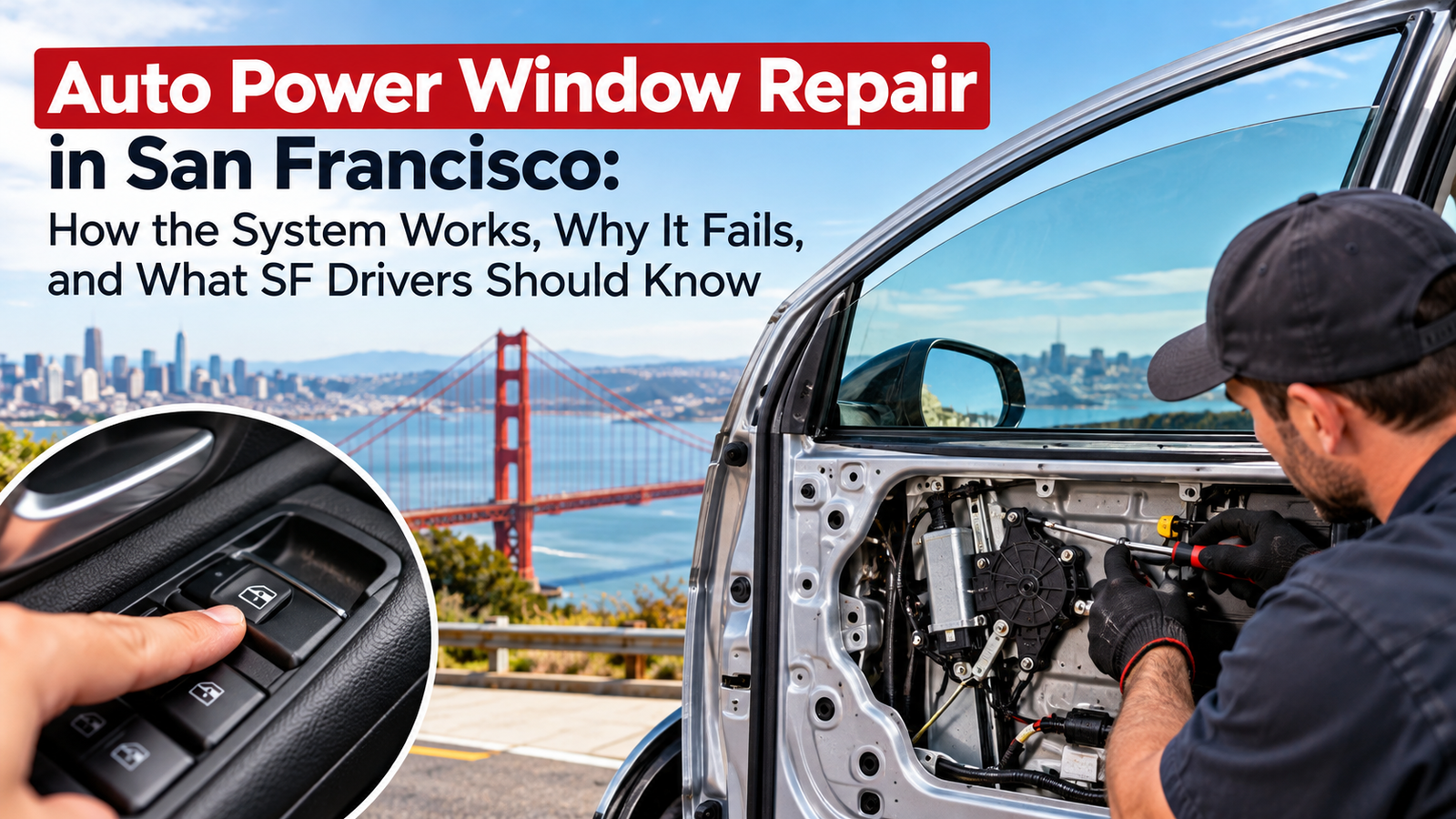
An Auto Power Window Repair San Francisco that stops working is one of the most immediately inconvenient vehicle problems San Francisco drivers encounter. In a city where parking enforcement is active, parking garage entry requires rolling down the driver’s window, and the marine layer means a window stuck in the open position can leave an interior saturated with fog and condensation before morning, a failed power window is more than a minor nuisance. San Francisco’s vehicle population also skews toward late-model, feature-rich cars the technology sector’s prevalence means a disproportionate share of vehicles with advanced electrical systems where a power window failure can intersect with vehicle alarm systems, door electronics, and other integrated functions.
How Power Windows Work: The Four-Component System
Every power window operates through a four-part system: the switch, the wiring and relay circuit, the motor, and the regulator. All four must function correctly and in sequence for the window to move. Understanding each component explains why different failure patterns indicate different underlying problems.
The window switch is the control interface the button on the door panel or the rocker switch in the master control cluster on the driver’s door that initiates window movement. Switch failure can be complete (no response when pressed) or intermittent, and driver’s door master switches wear out faster than individual door switches because they operate all four windows and are pressed far more frequently.
The wiring and relay circuit carries electrical current from the switch to the motor. The most mechanically stressed portion is the section that runs through the door hinge area the bundle of wires that must flex every time the door opens and closes. Over the lifetime of a vehicle, this hinge-area wiring flexes tens of thousands of times, and internal wire breakage (where the outer insulation is intact but the conductor inside has fractured) is a common failure mode in older vehicles. San Francisco’s damp marine layer creates additional corrosion risk at connector points throughout the door wiring circuit.
The window motor is the electric motor inside the door that drives the regulator. Motors can fail through worn carbon brushes, seized bearings, or failed windings from overheating. Gradual motor failure typically produces progressive slowdown before complete failure. Sudden motor failure produces an inoperable window with no motor sound when the switch is pressed.
The window regulator converts the motor’s rotational output into the linear up-and-down movement of the glass. Regulators use either cable-and-drum mechanisms or scissors-type linkage arms. Cable regulator failure typically produces a sudden dramatic failure the cable snaps or slips off the drum, and the glass drops into the door with a thud. Scissors-type regulators wear at pivot points, producing grinding or clicking sounds before eventual failure.
San Francisco-Specific Factors That Affect Power Window Reliability
The marine layer environment that characterizes San Francisco’s climate creates specific stresses on vehicle electrical systems. Morning condensation accumulates on vehicle surfaces throughout the year even in summer and over time this moisture works its way into door seals, window switch gaps, and connector housings throughout the door electronics. Moisture at electrical connections promotes oxidation of the connector pins, increasing resistance and creating the intermittent failure patterns that are among the most diagnostically frustrating power window problems.
The prevalence of vehicle break-ins in certain San Francisco neighborhoods adds a power window dimension specific to the city. A window stuck in the partially or fully open position because of a switch or regulator failure leaves the vehicle vulnerable in a way that is particularly serious in San Francisco’s vehicle crime environment. A window that cannot be fully closed should be treated as a security emergency and repaired or temporarily secured as quickly as possible.
San Francisco’s parking enforcement environment with its active street cleaning enforcement, neighborhood permit zones, and commercial loading zones often requires drivers to quickly roll windows down at pay stations or to communicate with parking attendants. A driver whose window doesn’t work reliably in these situations faces both the operational inconvenience and the potential for additional enforcement complications.
Diagnosing Which Component Has Failed
The failure pattern a driver observes provides the best initial diagnostic information about which component has failed.
All windows stopped working simultaneously: this pattern most strongly suggests a blown fuse. Every vehicle has a fuse protecting the power window circuit, and if the fuse has failed usually from a short circuit or a sudden current surge all windows on the same circuit stop working at once. Checking the fuse box and replacing a blown fuse is the simplest and least expensive possible power window repair. If the replacement fuse blows again immediately, an underlying short circuit needs to be located and repaired before replacing the fuse again.
The driver’s window works but passenger windows don’t: check the window lockout switch on the driver’s door panel before assuming a more complex failure. The window lock button cuts power to the individual door switches while leaving the driver’s master switch functional. Many unexpected “all passenger windows stopped working” reports trace to an accidentally activated lockout button.
One window won’t move at all but makes no sound: the fault is in the electrical path switch, fuse, relay, wiring, or motor has failed completely. A technician tests power at the switch, power at the motor, and motor ground to locate exactly where the circuit is broken.
One window won’t move but you can hear the motor running: the electrical circuit is intact and the motor is operating, but the mechanical connection to the glass has failed. The cable has likely snapped or slipped off the drum, or a mechanical component of the scissors mechanism has broken. The glass is sitting unsupported in the door and should not be operated until repaired, as the glass can fall and shatter.
Window moves slowly or stops partway through travel: a degrading motor is the most common cause of progressive slowdown. Increased friction from worn or dirty window tracks, or weatherstripping that has hardened and increased resistance, can also cause slowdown. Track lubrication with silicone spray on the rubber seals is a simple maintenance step worth trying before assuming motor replacement is needed.
Mobile Power Window Repair in San Francisco
Mobile auto glass and window repair service is particularly valuable for power window failures in San Francisco. A vehicle with a window stuck in the open position poses an immediate security risk if it must be driven across the city to a shop or left parked on the street for a scheduled appointment. Mobile service addresses the problem at the vehicle’s current location, whether that’s a residential parking spot in the Mission, an office building parking structure in SoMa, or a Caltrain lot in a surrounding Peninsula community.
For many San Francisco residents who access their car on an as-needed basis from a parking garage, mobile service also removes the practical challenge of driving a vehicle with a compromised window through San Francisco’s traffic to reach a fixed shop location. The technician assesses the failure and performs the repair on-site, and the vehicle owner drives away with a functional window.
Frequently Asked Questions About Power Window Repair in San Francisco
How long does power window repair take? A switch replacement takes 30 to 60 minutes. A motor and regulator replacement (the two are often replaced together as a combined assembly) takes 1 to 2 hours for most vehicles. Wiring diagnosis can take longer if the fault is intermittent and requires careful circuit testing to locate. Mobile service schedules these repairs at the vehicle’s location.
Can I operate my window if the regulator has failed? If you can hear the motor running when you press the switch but the glass doesn’t move, the regulator has failed mechanically. Do not continue pressing the switch in this situation the motor running against a failed mechanism can overheat the motor, turning one repair into two. Leave the window in whatever position it’s in until a technician can assess and replace the regulator.
Does California insurance cover power window repair? Standard auto insurance comprehensive and collision coverage does not cover power window mechanical failures from normal wear. If a window mechanism was damaged in a covered collision event, the associated repair may be covered under collision. Check your specific policy terms and contact your insurer with the specific circumstances of the failure.